Showing posts with label rock tomb. Show all posts

Friday, February 26, 2010

Turkey 5 : Devotional Road

Sumela Monastery was founded as early as 4th centry, re-builit and restored for many times in dfferent centuries, by different empire of Turkey. Devotional road is always not an easy journey of life. Many monasteries of different location and different religions share similarities, where they are mostly built in places away from cities, up on the hill slope, or hidden in forests and caves in order to provide a quiet place for prayers and learning.


Sumela Monastery was located in Macka region, and it is basically built into a steep slope of Karadaglar/Black Mountain. From the valley, visitors need to walk uphill for about 30 minutes to reach the entrance of the monastery. The journey is short, but many parts are quite a steep walk. There are plenty of maple tress along the way, and the colorful maple leaves beautifies my journey up to the monastery.

A long and narrow stairway leads me to the entrance of the monastery. Among the major elements in this monastery are the Rock Church, chapels, kitchen, student rooms, library, guest rooms and sacred spring. However, only limited compartments are opened to public/visitors.


The inner walls and outers wall of the Rock Church and chapels are decorated by frescoes. These frescoes were made as early as 13th century during the reign of Alexios III of Comnenian Empire of Trabzon. These fresoces can be in the inner wall of Rock Church.


There are different kind of frescoes used to decorate the early churches. Some are painted directly on the rock wall, while some are painted on to a thin layer of plasters on rocky wall, and this is the type observed in this monastery.

The frescoes found in this monastery are badly damaged, but the outline of the frescoes can still be observed clearly. The main subjects of these frescoes are biblical scenes, as well as stories of Jesus Christ and the Virgin Mary.

The outer wall of the church is filled with frescoes of various biblical scenes such as resurrection of Jesus Christ, etc. However, I notice that many frescoes of people are destroyed, with either both eyes or face gone. After I asked the guard stationed in this monastery about the reason, then I know that when Islam came to Turkey, many frescoes related to Christianity are destroyed by Muslims and in their belief, a being is represented by both eyes or face. Therefore, most of the frescoes ended up with both eyes or face gone.


Devotional road is always about faith. Look at how the devotees of the world, of various religions practice and devote themselves to the God or to what they believe. It is always a wonderful experience to visit religious places and learn about others' religions or belief.

Note : Aya Sofya Museum is also worth a visit in Trabzon. This is not the Aya Sofya in Istanbul.

Saturday, November 21, 2009

Turkey 3 : Fairytale Ottoman Town of Amasya

After staying in Istanbul for two days, I decide to move into Central Anatolia to Amasya, a town with Ottoman architecture. I bought myself an overnight bus ticket from Istanbul, and it took me around 8 hours to reach Amasya. The petrol RON95 price in Turkey is around TL3.80 per liter, but the long distance bus fare is considered at reasonable rate, and the service are good. Drinks e.g. hot tea/coffee, fruit juice or soft drink will be served during the bus trip. Besides that, when you purchased bus ticket, they will note down whether you are "Bay" or "Bayan" and solo female traveler will not be seated beside a male stranger.

The bus reached Amasya Otogar (Bus terminal) around 6am the next day before it heads for its last stop in Tokat. I was a bit blur waking up early in the morning, but luckily there is always minivan transfer service by the bus company from the Otogar to the town center. Most of the bus terminals are located quite a distance away from the town center. However, I encounter one minor problem during the transfer, as the driver and passengers do not speak any English, and the driver is sending the passengers back to their home which is not in the town center where I want to go to look for hotel. I am the only passenger left in the minivan by then, and I was trying my very best to tell them when I wish to go, and even show them the map in my Lonely Planet (But it doesn't help). And one last try after that is I picked my mobile, dial the number of a hotel located in town center, and pass the phone to the driver...and it works. After that incident, I learn a new Turkish word - Sehir Merkezi which means centrum or town center. Thanks for the patience of the driver sending me right in front of the hotel.

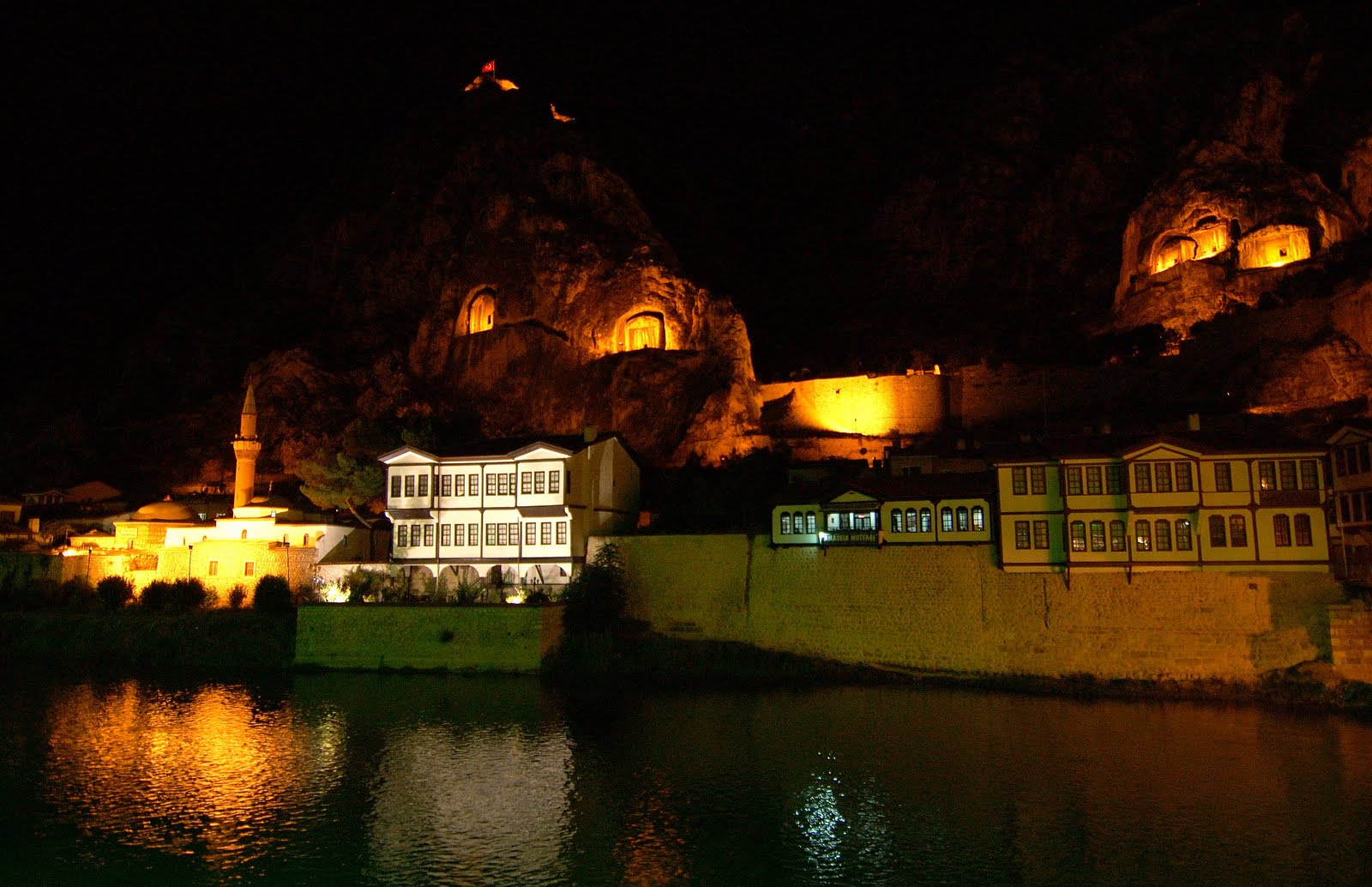
Amasya, located in Central Anatolia Turkey is a city with fairytale Ottoman mansions (Konaks) along the Yecilirmak River which is located in between two great ridges of rock. It is very similar to the villages in China which are built along the riverbank. Ottoman mansion basically has wooden frame with rock or nowadays bricks used for the wall. Many of these old mansions have been restored, and Hazeranlar Konagi which was restored in year 1979 is now converted into a museum open to visitors.

Besides its attractive architecture, there are rock-cut tombs of the Pontic Kings up on the mountain at northern bank of the river. These tombs was built as early as 4th century BC, but now all tombs are empty. The rock tomb are cut in a way that there is a passageway round the tomb, but a gate is built and no visitor is allowed. The views over the town also make the climb up to the tomb worthwhile. Both southern and northern bank can be seen clearly up here. Most Ottoman houses are found in northern bank, while new town scape can be seen in southern bank of the river.

Amasya is also famed for its apples. I bought some and tried, juicy, sweet and good taste. It is a relaxing moment walking alone the river banks, enjoying the cool breeze with beautiful Ottoman building hanging at the riverbank. Amasya is also famous for one of the Turkey's best-loved folk tales, the tragic love story of Ferhat and Sirin, which is similar to the story of Romeo and Juliet. And this folk tales make this place a romantic place to be. A statue of the two lovers is built at the southern bank of the river.

I stayed in a small hotel in the town center, and the hotel owner Mr Kenan owns also a restaurant just next to his hotel. He is very friendly, and his friendliness is not the cross-border type even though he knows that I am alone and not married. I feel comfortable resting in the lobby, doing my last minute plan where to next and writing some notes. Mr Kenan will serve me Cay and make sure I am comfortable. He is so interested to know how his name is written in Chinese, and I wrote to him as 柯南 (Isn't this one of the famous detective in comics?) When he knows I am looking for the direction of the mosque with spiral minaret, he even personally brought me there.

There are many mosques or camii all over Amasya. The mosque with spiral minaret named Burmali Minare Camii, is more unique among others. It was built by the Seljuks between 1237 and 1247, with elegant spiral carving on the minaret. Besides the unique minaret, there is obvious Seljuks influence in the architecture.

A small peaceful town, which marked a good start of my journey into Eastern Turkey.
Please visit http://www.flickr.com/photos/ahbeelim for more photos of Amasya.